Showing posts with label paris. Show all posts

Sunday, March 25, 2007

You call this a vacation? Long days, no weekends, but great sights, people and food

I’ve already heard from some folks back home about what a great “vacation” this is. Let me clarify: vacations involve downtime, relaxation, no schedules, and hopefully, fruity drinks. Using those criteria, this experience does not qualify.

We have very full daily schedules and our days typically begin at 9am for a group meeting and travel to the first of several lengthy group meetings and discussions with local officials, personal appointments with local leaders and activists in our areas of interest, more meetings/discussions with officials and Marshall Fund contacts over lunch, followed by more meetings or tours of historical sites or political institutions until 5 or 6pm.

Barring travel time, we may have a short break before heading out at 7 or 8pm for dinner meetings that often last until midnight or 1am. In every European city we’ve visited thus far, lunch and dinner are long meals (2-4 hours) and dinner especially begins and ends much later than most of us are used to at home.

For this reason, breakfast is critical, and fortunately, it’s been included with our room stay in every city. So here’s an example of a power-up breakfast to get me through the day in Copenhagen. Tasty, yes? :-)

The Danes typically start meals (including breakfast) with fish, such as pickled herring, as evidenced by this herring “bar” at one restaurant. I tried it and enjoyed it, but one of my lessons of the day in Copenhagen was that pickled herring on an empty stomach does not really agree with me. Another fellow suggested I start with a bread buffer layer on future attempts. Note to self.

We usually spend 4-5 days in each city, with at least a day, sometimes more, spent traveling in or out. The remaining 3-4 full days, weekends included, are packed with meetings and activities. So I’m often up until 2am or 3 am just handling other daily duties, such as checking in by e-mail or phone with family and friends, and most importantly, doing laundry in my room.

Dry cleaning is exorbitant everywhere in Europe, so I took the advice of previous fellows and brought lots of stretchy but business-appropriate cotton/lycra shirts and sweaters (not to mention underclothes and even one pair of suit pants), which can be washed by hand and dried over a night or two. This would come in handy when my luggage took off on a side trip of its own partway through our travels. Twice.

So while this trip is providing unparalleled access to international locales, leaders, sights, sounds, and cuisine, it is not a vacation. Although I did finagle one fruity, non-alcoholic drink in Paris. ;-) Bottoms up!

Monday, March 19, 2007

Closing out Paris

This trip has been nearly non-stop with activities and meetings. It's been fun, illuminating, enlightening and draining. But I'm meeting such interesting people and learning so much that I fall into bed happily exhausted each night.


Our last night in Paris, I met with Marie-Claude Peyrache, President of European Professional Women's Network-Paris (PWN) and former director of Communication at France Telecom. Their mission is to work women's progress in the business world.

I'm very interested in professional and leadership development for women and communities of color, so I found PWN online before I left and asked to meet Ms. Peyrache or someone from the organization. The group began as a way for professional women in Europe to build the kind of networks that can help them blossom professionally, develop leadership skills, and build confidence in their ability to join and succeed in the executive ranks.

Ms. Peyrache said women in Europe have only started to really move up into the professional ranks in large numbers in the past 10 years. The organization has chapters in most of the major cities in Europe, except in Germany: there is still more pressure on women there to stay home with young children rather than entering the job market outside the home. I would later learn this is very different from Denmark, where 80% of women work! But the Danes also have a very strong benefit system that provides a year of paid maternity leave, similar availability for men, and low-cost, subsidized childcare. The result is a society with strong support for families and work/life balance, plus very low unemployment among native Danes. Hear that U.S. lawmakers?

We had a very good meeting and she provided some good tips for growing your membership, providing networking opportunities, and assisting with professional development and mentoring that I'll be taking back to the Seattle Urban League Young Professionals, a professional development and social service organization with which I've been involved for the past couple years.

The highlight of the Paris stay came that evening when I joined GMF fellows Chad from DC and Carrie, a museum administrator from Chicago at the home of Cyril, a former European German Marshall Fellow for dinner.

He and his family lived in the suburbs of Paris, which are much more diverse than the area around our hotel. His wife would later explain that she'd intentionally moved to that area because she felt their former neighborhood had been too homogenous and she really wanted to be aroundm, and have her kids experience life with, a variety of people.

They welcomed us into their home and plied us with delicious appetizers, food and drink for several hours. On a work/school night, no less! Cultural lesson of the day: Europeans generally entertain for several hours. This would be echoed in Copenhagen where our coordinator explained that people usually come for appetizers, drinks and dinner around 7 or 8pm and don't leave until after 11pm but before 12am on weeknights. On weekends, there's no set ending time. I loved it!

At Cyril and Caroline's, we met their sons (who were adorable and smart), and listened to great jazz music while getting acquainted over wine (juice for me, as usual), bread, cheese and olives. We eventually moved over to the dining room where they ramped up the gastronomic pleasure level even more with scallops and oysters in a delicious butter sauce (perfect for sopping up with the bread), followed by roasted lamb and fingerling potatoes. Then there was a cheese course, and we wrapped up with ice cream and sorbet.

As if that weren't enough for a wonderful evening, they were all very interesting individuals and talked very candidly about French life, politics, the issue of immigration and integration of ethnic minorities (Caroline volunteers as a tutor for immigrant women to help them learn French and become more self-sufficient), and work/life challenges and options.


It was simply a wonderful evening and made me long to do more entertaining back home in Seattle. Rather than just waiting for the mega-holiday dinners, I plan to host more small dinner gatherings. With our fast-paced lives in the U.S., it's the only way I'm going to get to enjoy friends on a more regular basis.


Additional take-away from this experience: entertaining is not about volume or intricacy of food or whether everything is Martha Stewart-perfect, it's about spending time, building relationship and sharing time, food and home with someone simply because being in their presence is enjoyable. I'll try to keep that in mind as I return to the busy life back home.

Saturday, March 17, 2007

French National Assembly

Tuesday, we visited the French National Assembly, which is its parliamentary body. We'd planned to meet with a member who is a leading figure in the conservative caucus of the assembly, but election duties had called him away. So one of his staffers gave us a tour of the facility, which was very regal and impressive, as legislative buildings are wont to be,
especially French ones that go back hundreds of years.

Inside, they had these great gifts for political junkies: dinnerware to let the world know just what side of the political spectrum you (and your food) are on. Droit is right, gauche is left. They'd work just as well in the U.S., given our red/blue state divide after the last election.


Also inside, this cool bronze sculpture of a painter working by Louis Mitelberg entitled "Daumier creant Ratapoil." I just liked it for some reason.


...and this Versailles-esque dining room being set up for an official function. Get a load of the gilt, chandeliers, and ceiling frescoes. Why do I get the feeling that were this room in the states, it would cause a stir for being too ostentatious for elected officials?

Here's the chamber where the members meet to make decisions. GMF Fellow Michael from Austin, served as a spokesmodel for this shot after showing me how to adjust my flash for the lighting conditions in the room. Camera mechanics, energy policy, knowledge of obscure political facts and research, and cracking the rest of us up with his asides are just some of his many talents.

We also passed through the members' library, which is an almost perfect replica of what heaven looks like in my brain, except that in addition to floor to ceiling books, my version has dogs underfoot and hot chocolate on tap. Guilty confession: I've been drinking almost one hot chocolate a day on the trip(!). They've been exquisite in both Paris and Copenhagen. Good thing we're walking a lot.

Over in the mail room, which was where members of parliament used to come to read and respond (by hand) to constituent letters, they have these great chairs. They were built oversized so that members could read a wide open newspaper without disturbing or encroaching on each other's space. How's that for form following function? I love it! And I want one. Note to Jason.
PS - you'll notice the functional hair I'm sporting. That's what happens when your flat iron falls victim to the quirks of international voltage changes. To do list for the evening: find a store with hair appliances.

Copenhagen preview, Paris politics and educational inequities

I'm in Copenhagen, Denmark now and it's continued to be a whirlwind trip. I'm way behind in posting. Every day is so jam packed with meetings and activities, I can barely stay awake when we return to our rooms each night. Plus, Copenhagen is REALLY expensive and there's no free wireless in the hotel, but it's great awesome otherwise.
I'll be traveling with a smaller group of GMF fellows in each of the next few cities, until we rejoin everyone in Brussels at the end. For now, the Copenhagen crew left to right below is Michael the professor from Texas, BryAnn the Exec. Director of a non-profit for immigrant women in Atlanta, Chad, the think tank guy from DC, me, and Cal, the attorney from North Carolina.
We spend each day together being briefed in meetings, absorbing info, asking questions, cracking each other up as we debrief during walks and cab rides to each venue, deciding where to eat each night if there's no dinner meeting (a surprisingly easy process), and tallying up who owes who how many kroner, euros and dollars for shared taxi rides, meals and host gifts. I don't know if the GMF staff chose potential fellows for having great senses of humor and being easy going, but they certainly succeeded with this bunch.
Here's a shot of my cool Danish room...which overlooks a bay and the opera house across the water. Motel 6 it ain't. This place is great.


One adjustment we had to make upon arrival is that although Denmark is part of the European Union, it's not on the Euro. Their monetary unit is the Kroner and currently it's about $1 USD = 6 Kroner. So the 300 Kroner I took out of the ATM was only about $50. Note to self.
But back to Paris. Here's a speed round summary of some of the activities during our last couple days there, which were wonderful. On Monday, we gathered in the hotel lobby for the continental breakfast included with our room, which was great. Buttery, flaky, mini croissants, muesli, dried apricots, prunes and figs, fresh fruit, yogurt, juices, coffee and hot chocolate. For the remainder of the stay, breakfast became a great way to power up for the day and catch up with folks who'd gone to personal appointments or other activities the night before.

Our first stop that day was a meeting with a reporter from L'Express and a Research Director from the Center for International Studies who talked with us about the French perspective on the European Union. Their general take was that the French political class had slowly allowed their influence
and stature on the world stage to erode as the UK seized leadership in Europe.

As examples, they pointed to the lack of interest in the French socialist approach to global issues, and the increased interest by Europeans and young people in how to adapt to the Anglo-Saxon/UK way of operating a country, with high growth, free markets, and the like, rather than the French way. They also pointed to the brain drain from France to other EU
countries and the U.S. Apparently, recent research indicates there are about 400,000 French people living in London, a number that would make it the 7th largest city if it were in France.These sentiments would be echoed and validated later that day when we met with students at a public high school.


But first, we had a a fantastic lunch and primer on immigration and access to education in France. We learned that education is fully funded by the state and students begin school with a rigorous pre-school program from ages 2.5 to 6 years. The rest of school up through the equivalent of our
high school is similar to ours, except that at age 16 or so, French students' GPA and test scores are used to funnel them onto either a vocational or classical/professional track. Once on that track, it is nearly impossible to change. Essentially, they must decide at 16 what they will be doing for the rest of their life! We would hear the students' worry and angst about this later.

However, it appeared to that they are funneled into a path much sooner, because social class has a lot to do with what schools kids go to, how good the schools are, and thus how well prepared they are for the testing to come later. The school principal there also told us kids who do the classical
track must also do two 8 week internships in their last two years of school, but because of France's class system, it's often hard for students whose parents don't have connections to find internships. Knowing this, they opt for the vocational track.


In fact, 60% of kids from poorer neighborhoods go the vocational track, likely because of these systemic roadblocks. But when asked about how this puts poor and immigrant kids at an automatic disadvantage, the response was that although some reforms were being considered, they told us, "It works pretty well and this is the way it's been set up." Basically the classic: this is how we've always done it, a phrase which irks me to no end, no matter the context, because it's a cop out for not trying to change things or look for ways to do them better. Yet we would repeatedly hear discontent with the status quo: very frustrating.


We take turns presenting gifts from our home state or city to our hosts. This is me presenting our speaker with a gift pack depicting beautiful pictures of the Pacific Northwest and a cool, hand carved bookmark from the Seattle Public Library.

That afternoon, we met with high school students to learn about their lives and interests. These students had been chosen to meet with us because they had very good English skills and were clearly tops among the student body. They were very smart, mature, and very knowledgable about some things in the U.S. But they also had some misconceptions, which was no
surprise since they said they'd perfected their near-flawless language skills by watching American TV and movies.
As students in their last year of school, they expressed concerns about having to choose their life's path in the next few months. Yet overall, they felt the French education system was much better than those in the U.S. because they saw it as a meritocracy, where smart kids could go to college for free, while it cost way too much to go to college in the U.S.
"Your parents shouldn't have to pay for an education," one girl said. While we agreed their system was better in that respect, and in its apparent rigorousness, we also pointed out that there are lots of ways to fund an education here and that our system provided the flexibility they craved to decide their life's path later, or change it altogether. "It's possible to succeed in our system without connections and without a degree at all," I pointed out. "A test at 16 or 18 does not set your life's course."

I also begged to differ with the meritocracy suggestion. Although public schools are free, just as in America (and even private schools are subsidized by the government) they are not all created equal. Getting into the good ones in Paris depends on where you live (also similar to the U.S.). But Paris is naturally segregated, with white and more affluent families in the center, and poorer and immigrant families typically farther out in the suburbs, where, not so coincidentally, the schools are not as strong.
So I pointed out, it was not just good grades and test scores that brought them together in that class, it was the social class of their parents, who presumably, could afford to live closer in. Smart kids who were not fortunate enough to born into the right family or neighborhood were out of luck. They didn't really respond and really, it was a rhetorical remark, because I could tell by looking around the room and the courtyard filled with students that it was a pretty homogenous place.


This topic obviously hits home for me because I feel fortunate to have had a teacher who looked beyond my skin color and saw my academic potential, and who recommended me to a school that nurtured, celebrated and developed that potential; A school that has made part of its mission finding today's talented kids, regardless of their background or family status and providing them the same opportunity to excel in a rigorous, academic program.

So it bothers me to hear French educators and students acting as if they operate in an egalitarian meritocracy when there are no doubt many, many kids out there who could be attending these more rigorous schools and using them as stepping stone to a better future, just as better connected students do, if not for their family name, religion, income level, and address.


But the discussion was not as much of a downer as that last paragraph might indicate. I shared the discussion with two other fellows, so we also
discussed the regional differences in education and other attitudes in the U.S. since I'm from Washington State, Jeff is from North Carolina, and Hussein is from Minnesota. It was an informative discussion all the way around and we enjoyed the students immensely. They were very forthcoming and amazed us with their near-flawless English, which they apologized for(!). Uh, it's WAY better than our French, we told them.


Some fellows headed off to personal appointments, but since I had none, I trekked back to the hotel by wandering through several neighborhoods and shopping districts in search of fountain pen and stationary stores before hoping the Metro for my temporary home. With all the walking to and from our meetings, I was beat! So I opted out of the small group dinner and settled for a simple teriyaki dinner from Tokyorama down the block before turning in. I love this city, but it wears you out!

Wednesday, March 14, 2007

French politics: countdown to the election

Sunday night, we had our first briefing on the political structure in France. French voters will head to the polls in May to elect a new president, replacing Jacques Chirac, who has been the country's leader for 12 years, and in politics in France for 40 years.
There are three leading contenders (and at least three lesser known ones who pollsters believe have little chance of actually impacting the race). The forerunners are Interior Minister Nicolas Sarkosy, 52, Socialist Segolene Royal, 53 and Francois Bayrou, 55. Royal has drawn the most media attention because she's believed to be the first woman with a real shot at being elected president of France. Obvious comparisons are also being drawn to Hillary Clinton in the U.S. race.
In doing research for this trip, it was easy to see that media coverage of France's elections have intensified in just the past few months, with the election just a couple months away. We Americans (and the candidates)have to endure (and fund) nearly 18 months of media ads and campaigning. That's largely due to France's "tight limits on campaign spending and a ban on political advertising on commercial hoardings in the three months preceding an election." (Reuters: Advertising big guns out for French poll.)

We had the pleasure of learning more about the elections during a fabulous dinner with:
  • Stephane Rozes, Director of Opinion Polls and Institutional Studies for CSA, an independent administrative authority that was created to guarantee broadcasting freedom in France, which is somewhat like our FCC, and

  • Harold Hyman, a journalist with BFM-TV, a new information outlet using TV, cable, satellite and internet. That's me and Harold below.


They gave us a great overview of the upcoming election and the candidates, however when it came time for questions, one of the GMF fellows remarked that it all seemed to be more about the personal histories, personalities, and positive or negative relations between the candidates and/or Chirac than about issues of importance to the average voter. Yes, I know this sounds similar to the U.S., but it seemed magnified. Where they stood on the issues was not mentioned until we asked.
Our hosts explained that in France's party-run system, issues are set by the parties, not so much the candidates, so issues are not discussed much during the campaign.

I asked about the role of women and minorities in politics since Segolene Royal's ascendency was being so trumpeted. Are there others in the pipeline behind her? The answer is no, again, due to the party structure, which our hosts said makes it very tough for them to rise through the ranks from the local level to national prominence, and even then, it is a very long process, like decades.
I found that discouraging, and was reminded that it was only in mid-2006 (!) that France's national TV channel hired Harry Roselmack, its first black anchor and what an uproar that caused. And that came a year after Chirac urged the media to hire more ethnic minority journalists, and even that tepid boost only came in reaction to riots by Arab youths.

Another GMF fellow asked about the integration of religious and ethnic minorities in France and how that was being handled by the presidential candidates. The ensuing discussion veered off into the headscarf issue that had been hotly debated in France recently: whether to allow the growing number of Muslim girls in school wear traditional headscarfs. A panel was convened to discuss the issue and came up with 25 rules governing religious symbols in schools.
Coming from the Pacific Northwest, one of the least churched areas of the country on a per capita basis, I admitted that I found this amazing because none of the issues being mentioned as the root of the hubbub were at all related to the actual education the kids receive. It was all about perceptions by others and the messages it might send.
When I was in school, I played basketball with a girl whose religion did not allow her to wear pants, and certainly not our uniform shorts. Rather than convene a panel and go the French route, school administrators simply let other schools in the league know that she would be playing in a uniform top with a floor-length skirt for religious reasons. No one really batted an eye and life went on.
Our hosted reminded me that it was a much bigger impact in France, with hundreds of girls taking to wearing the scarves. Also, the panel approach came out of centuries of distrust of mixing church and state/religion and education because the church in France had supported the monarchy and its oppression of the masses before the masses revolted.
"So our feeling is we do not want religion in schools, we do not want religious symbols in schools," said Stephane. "Our view is 'keep the priests off our kids'."


"That statement has a whole different connotation in the U.S.," I said, "But I understand your point."

Our well-fed, better-informed, little group at the end of the night.
The whole evening was filled with questions and discussions like this, comparing and contrasting the French and U.S. approach. Coming in to this trip, I was an avowed lover of all things French, except for the whole absolute monarchy bits mentioned in my previous post. Now, I'm starting to get a more rounded and complete view of the country's complexities, and even its negative aspects, which was inevitable given my overly-rosy view coming in. That's not a bad thing. I see the shift as a result of a more informed view. And being more informed is almost always good.

Versailles: gilt-y as charged

Sunday morning, four of us and our Paris coordinator hopped the Metro to Versailles just southwest of Paris. First, some quick backstory. Although the village (now city) has been around since 1000 AD, it's relevance to the French monarchy begin in the early 1600s when King Louis XIII built a hunting lodge on what was then wooded farmland far from the main castle in Paris. Today, Versailles is a city in the suburbs of Paris.


Louis's successor, Louis XIV undertook a major upgrade and renovation of the chateau in 1661. If you've ever struggled through a home renovation with sliding deadlines, you'll appreciate this: it took 21 years to complete the palace at Versailles. But oh what a project. If I had to describe Versailles in two words, I'd go with gilt and gi-normous (as in gigantic and enormous).
Keep in mind, all the marble stone, floor to ceiling windows, stairwells, wings, EVERYTHING, was built centuries before mechanized construction equipment, computer-aided drafting, and OSHA rules.
Imagine what it was like for the laborers and the precursor to our general contractors. "What do you mean you lost a hand moving a 1/4 ton marble slab for the queen's dressing room? Tough. Try not to block the courtyard with your begging. By the way, the marble wasn't damaged, was it?"
As impressive as this place is, I can't help but wonder how many people died or were maimed in its construction. The royals were not similarly burdened with such thoughts. They saw the largesse as a birthright. In fact, Louis XIV built it out in the sticks away from Paris because he wanted a site that fit his view of an absolute monarchy. A place where he could organize and completely control tne government of France by absolute personal rule. Over the years, he would expand it into the largest palace in the world. It worked great for him and his progeny until the people got a little peeved and started a little dust up called the french revolution in 1789.

But leaving all that aside, the place is mind boggling in its opulence, especially for that time period. After a couple hours of listening to an audio guide describe each room and walking marble corridor after marble corridor of gilt mirrors, hand-stitched, minutely detailed fabric wall coverings, ornate decorations, larger than life size statues and 40-foot ceiling frescoes, my mind just shut down. Oh look, another opulent chamber, like the other six before it.
We barely explored the grounds, which were a whole other expanse of incredible landscape design.

It was definitely worth the trek though.

Tuesday, March 13, 2007

Paris arrival and food, food, food

So we made it to Paris and checked in to our charming hotel on a side street in the St. Germain area. Cute, cozy room and courtyard view from my window below.


The weather has been amazing: low-60s and sunny every day. When we arrived on Saturday, I caught up with my middle and high school buddy Holly who married a Frenchman and moved here a couple years ago. We missed each other last time I was in town, but I was determined not do do that again. Life's short after all, so you should see friends (especially old ones) as often as you can. :-) Despite a jam-packed schedule, I scurried through the Metro to connect with her and her adorable son Philippe near the Eiffel Tower. Not only is she still as fun and beautiful as ever, she jumped into action when I mentioned that I'd under-packed (yes, after all that angst) and I needed to find a Gap ASAP. Usually I refuse to buy any clothing or food abroad that I can get at home, but sometimes a girl just needs some basic pants, t-shirts and a sweater that fits. :-) So we beelined for the nearest Gap (of course just a couple blocks away), and caught up as we both surfed the racks.


From there, I rushed back to the hotel for our first briefing and dinner with the other fellows.
So we swarmed a tiny neighborhood restaurant around the corner. I say swarmed because we walked in en masse, buzzing with group energy and trip excitement. And in Paris, "tiny neighborhood restaurant" is redundant. The ones away from the tourist areas all seem to hold about 12 people, not including the waitstaff and chef. The entire "dining" room would fit into the waiting area of the average Outback Steakhouse eatery in the U.S.


But instead of choosing from glossy pictures of by-the-book entrees in a laminated menu, all slapped together assembly-line style by indifferent kitchen staff, meals in Paris are beautifully prepared. They are clearly crafted to be lingered over and savored, first by the eyes, then by the palate, not scarfed down while driving and reading a Blackberry (I left mine at home).


In fact, we haven't seen any to go cups or containers since arriving. You're expected to sit and enjoy your meal or beverage, even if it's just a simple hot chocolate, which is my favorite treat here. Notice the size: about 6-8 oz. of pure, rich, chocolatey goodness. Not 12, 16 or 20 ounces.


Coming from supersizeland, it's an adjustment initially. But you soon realize that by eating smaller but more flavorful servings, you feel satisfied sooner, and you can eat more good stuff later without feeling as if you're going to pop a button and take someone's eye out across the aisle on the Metro.


So check out David, another fellow who is an attorney from Cleveland and his beautifully arranged plate. That's crostini topped with smoked salmon and perfectly diced and sauteed vegetables. Note that it is not a slab of salmon and it is not on a platter that could also double as a serving dish for a holiday turkey. And that's just the appetizer!


Here's an artfully arranged salad appetizer with balsalmic vinaigrette and a small breadstick.
And my appetizer: a buttery, flaky tart, topped with flavored sour cream or something (I was too busy eating to double check), perfectly cured prosciutto, sauteed red peppers, cilantro and a balsalmic reduction sauce of some sort. I remind myself that it's bad form to lick a plate in public, even if you can do it stealthily.

Sunday, I'll opt for a tour of the palace and grounds at Versailles, before a dinner and briefing with the fellows and two journalists who cover the U.S. and French politics. More fun to come.

Friday, November 11, 2005

Death of a dream: monorail voted down

I'm in a bit of a funk over the outcome of the local election on November 8. In a 65% to 35% vote, Seattle voted to shut down the Seattle Monorail Project, just two months from the start of construction. Two months! People outside this area are flabbergasted (links to PDF of article from London) that it even had to be voted on five times and that the Mayor and City Council wouldn't support it.

Part of what's so frustrating is that so many people bought into the lie that the money spent to date on the Project was "wasted", even before the vote. $70 million of the $180 million spent bought property that will now be resold, likely at a higher return for taxpayers. The rest paid for all of the technical work, engineering, environmental impact review, public outreach and and coordination with other agencies that brought the Project to the brink of construction in a record 3 years. The national average for getting to this point is 7-12 years (!) and at a cost a lot higher than $180 million. Unbelievable. Now that we're not going forward, it will be wasted.

While I was in Paris, I met with the Communications Director for the Paris Metro system (That's him to the right. Yes, I'm on the job, even while on vacation).

He's worked for the Metropolitan system for 33 years (!) so he's seen all the ups and downs transit projects go through in getting built and expanded. Despite my rusty French, I was able to tell him about the monorail we were trying to build, how everyone was upset about the proposed cost, etc. It took him all of 5 minutes to assess the situation: "Ce n'est pas un problème financier. C'est un problème politique." It's not a financial problem. It's a political problem. Mais oui

Basically he said regional leaders lacked the political will to make the monorail happen and that while it had great public support, it lacked a politial sponsor willing to see it through and deflect the inevitable opposition.

One example he gave was that they were extending a line (of a decades old successful system) and still ran into opposition from a neighborhood activist who felt the construction was too noise, too disruptive and unnecessary. After some delay, the concerns were assuaged and the project continued. "Because this is what happens: people complain," he explained. "About the construction, the cost, the disruption. You deal with it and move forward. Once it's running, people love the system again and clamor for extensions to other areas."

Small consolation that apparently only people in foreign countries with excellent transit systems understand the benefits of the project we were trying to build.

Here's a shot of J. in a Metro station in Paris. I took several pictures in the trains. They were great! Clean, efficient, timely, affordable, and easy to navigate. We walked and rode the trains everywhere. Midway through the trip, my car-loving husband even remarked, "These trains are so convenient, I don't even miss driving. If I lived here, I wouldn't even need a car." Yeah, that's what having great transit will do for you. Too bad we'll never know what that feels like here in Seattle.

Oh yeah: the post-Paris buzz is definitely gone.

Thursday, October 27, 2005

Meat on the street

We are much closer to our food here in Paris than in the states. Meaning we see veggies arriving to the neighborhood markets, see people buying fresh seafood, veggies and bread daily.
Also, as evidenced by the attached picture, we see sides of beef being delivered on neighborhood streets, sans protective plastic wrap or covering, I might add. You might see that down at the public market in Seattle, but not on, say, the Ave in the University district, which would be equivalent to the neighborhood where we saw this. New experiences abound.

Open air elevated station

This one is similar in concept to what the Seattle Monorail Project's open-air stations will look like. Except several decades newer of course.

Garden outside Louvre

Tuesday, October 25, 2005

Open face chicken sandwich

How tasty looking is that?!

St. Honore shrimp dish up close

Shrimp lunch in St. Honore neighborhood

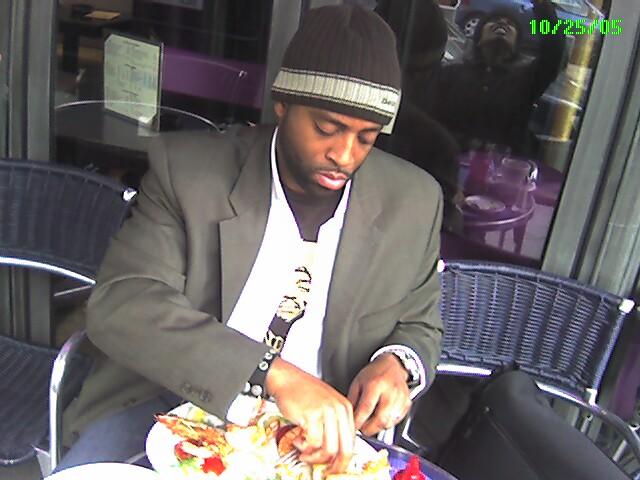
We stopped at this place Tuesday for a late lunch after walking the canals in another neighborhood. I had an open-face chicken sandwich: piece of grilled chicken on excellent bread covered in exquisite cheese then grilled. SO glad it's low fat. Yeah right!

I have yet to see any menu items labeled "heart healthy" or "low carb". I think that's completely contrary to the French approach, which is: highest quality ingredients, beautifully prepared to perfection for the palate. If that means the freshest vegetables, seafood and meats coupled with buttery sauces, real ham and bacon, and a healthy helping of cheese, so be it.
 
We know what that means healthwise, so either eat in moderation and walk a lot, or be prepared to find a caftan shop you like. Life's all about tradeoffs. :-)
 
Personally, I'm opting for the moderation and walking this week. When I'm back at my sedentary job, I'll post a list of my favorite Northwest caftan retailers. ;-)

Louvre: inside looking out

Shot of the massive courtyard on one side of the building. Acres of gardens unfold farther afield.

Mayhem at the Louvre

We visited the Louvre museum yesterday. It apparently receives 5 million visitors each year. It felt like 3 million of them visited the same day we did. The picture shows the crush of people in the entry under the giant glass pyramid. Note: this is just people waiting to buy tickets to get in! Definitely not the place for people with fear of crowds, or ambulatory problems: we walked for 2 hours and barely covered the wings on ancient greek and italian figurines, paintings and drawings.
I'll post more pix later showing how big this place is. But the art and buildings really do give you an amazing sense of history: the Louvre itself opened in 1793! More info and pix of their holdings here: http://www.louvre.fr/llv/musee/institution.jsp?bmLocale=en.
Favorite moment: the look on the face of two frazzled parents as they realized that, after a long wait in line and who knows how long getting to the museum, the amassed art at hand was less interesting to their two young kids than running and sliding across the marble floors on their knees. :-)

Metro musicians

Not sure if this will upload, but this is video of a group of musicians playing in one of the Metro stations. There have been different ones each day in the station nearest our apartment and it's a wonderful bit of culture in the sweat-tinged crush of people in the Metro's hallways.
The French really revere writers, artists and musicians; much more so than Americans on average. Some historians say that's partly why African American entertainers were so accepted here in the early 20th century, despite France's lack of acceptance of people of color from its former colonies in Africa, Asia and the Caribbean. The culture of celebrity definitely played a role. I'll add links to some interesting resources on this issue when I return. In the meatime, here's a link to an audio file from NPR's This American Life about life in France for American expatriates. The first couple a hilarious classics from NPR's Davis Sedaris. The 3rd or 4th one is by an African American attorney and author who moved to Paris in the 1990's for her job. She wrote a book about her rise from the 'hood to the Ivy Leagues, to attorney in Paris. http://www.thislife.org/pages/descriptions/00/165.html. Enjoy!